
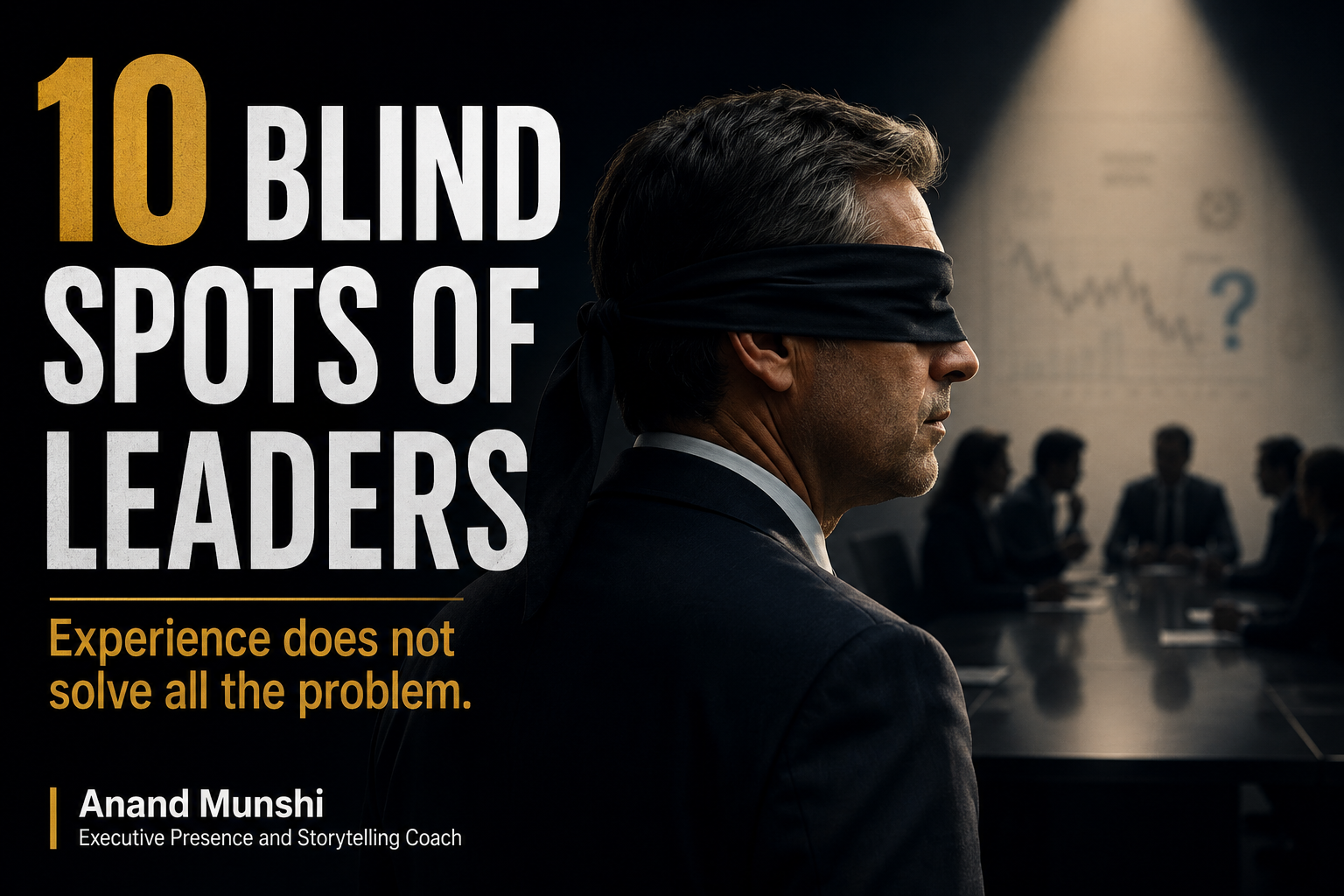
In boardrooms across the world, the challenge is no longer access to information. It is the cost of leadership blind spots.
Gallup’s latest global workplace data says only 20% of employees were engaged in 2025, and the lost productivity from disengagement was estimated at $10 trillion worldwide.
In India, engagement stood at 23%, and the productivity loss was estimated at $351 billion, or nearly 9% of GDP. At the same time, Edelman reports that 61% of people globally carry a moderate or high sense of grievance, and Microsoft’s Work Trend Index shows leaders are more optimistic than employees about AI improving their careers. In other words, pressure is rising, trust is thinning, and blind spots are becoming expensive.
Blind spots do not announce themselves; they arrive disguised as success.
1) Overtrusting
Overtrusting is believing that your systems, people, or past success will protect you from future risk.
It sounds confident. It is not. Boeing’s safety culture has been repeatedly scrutinized, with Reuters reporting a serious disconnect between senior management and employees, and a six-fold rise in employee safety concerns in early 2024.
The lesson is simple: what leaders stop questioning eventually starts hurting them.
2) Micromanaging
Micromanaging is control disguised as care. It usually begins with good intent and ends with low ownership.
Gallup’s 2026 workplace data shows manager engagement fell to 22% in 2025, and managers drove most of the recent decline.
When leaders hover over every detail, people stop thinking like owners and start behaving like operators waiting for approval.
3) Overexposure
Being visible is not the same as being valuable. Some leaders speak too often, post too often, and comment too often.
Their presence becomes noise. In a climate where 61% of people report grievance and high-grievance audiences see business as far less ethical and competent, visibility without substance reduces gravitas.
The room does not need more volume. It needs more meaning.
4) Overprioritizing Success
When leaders worship success metrics, purpose quietly leaves the room. Numbers matter, but numbers alone cannot carry a culture.
Teams begin to chase what is measured instead of what matters.
Gallup’s global engagement data is a warning: disengagement is not a mood issue, it is a performance issue, and the cost is measured in lost productivity, not just low morale.
5) Solving Everyone’s Problem Personally
Experienced leaders often become the first person everyone runs to. It feels helpful. It is actually dangerous.
If every problem returns to the leader, the organization never develops judgment below the top. Gallup and McKinsey both show how strongly management quality and engagement affect outcomes.
The better move is not to become the answer. It is to build people who can think, decide, and act without constant rescue.
6) Ignoring Emotional Drivers
People do not resist change only because they dislike change. They resist how it makes them feel.
Edelman’s 2025 Trust Barometer found that 61% of people globally have a moderate or high sense of grievance, and 4 in 10 would approve of at least one form of hostile activism to drive change.
That is not a communication problem alone. It is a leadership problem. Emotions ignored in the beginning become resistance at the end.
7) Speaking Before Understanding
Many experienced leaders answer too quickly. They confuse speed with wisdom. But when people feel unheard, they disengage long before they object.
Edelman’s research shows that high-grievance audiences judge business as 81 points less ethical and 37 points less competent than low-grievance audiences.
That should push leaders toward listening first. In trust-heavy times, the first job of leadership is not to speak. It is to understand.
8) Setting Poor Narratives
If leaders do not explain the “why,” people invent it. That is how uncertainty grows.
Microsoft’s 2025 Work Trend Index shows a gap between leader optimism and employee confidence on AI’s career impact, with 79% of leaders versus 67% of employees expecting AI to accelerate their careers.
When the story is weak, adoption slows, suspicion rises, and execution becomes uneven. Narrative is not decoration. It is direction.
9) Projecting Dummy Influence
Dummy influence is authority without credibility. It looks powerful in a presentation and weak in a real conversation. People may comply, but they do not commit.
In a world where grievance is high and trust is fragile, influence cannot be borrowed from title. It must be earned through consistency, judgment, and visible fairness.
The strongest leaders do not rely on position. They rely on trust that survives pressure.
10) Overpromoting Personal Brand
A personal brand becomes a blind spot when it is louder than the mission. Strong leaders do not build themselves at the expense of the team.
They build the team, and their credibility grows as a result. In an era where employees and stakeholders are quick to detect performance theater, authenticity matters more than polish.
The brand that lasts is the one that matches the work.
What leaders should do now
Start with a blind-spot audit. Ask your team one hard question: What do you see in me that I may not see in myself? Then build a simple trust dashboard: engagement, attrition, quality concerns, and decision speed. Finally, replace the habit of immediate answers with the discipline of deeper listening. Gallup’s data shows managers shape a large share of engagement outcomes, so change has to begin there. Small corrections, repeated consistently, become leadership strength.
Final line: Experience becomes wisdom only when it is willing to face its blind spots.
#ExecutivePresence #Storytelling #AnandMunshi #Leadership #Trust